The Medicine Cabinet Crisis

A Conversation About Completing the Prescription Journey
The Medication Stewardship Center exists to help redefine how each of us thinks about our own and our families' prescription journeys.
Our goal is to advance a conversation that positively influences behavior and inspires a safer future for patients, families, pharmacists and communities. Each month, we will explore an important part of medication stewardship, supported by information, perspectives and resources available through the Center (found at www.DisposeRx.com), asking how healthcare can better support patients and caregivers from the moment a medication is prescribed until the moment therapy is safely completed.
This is not simply a conversation about medication disposal. It is a conversation about Medication Safety and completing the prescription journey. And perhaps the best place for any of us to begin this conversation is inside our own medicine cabinets.
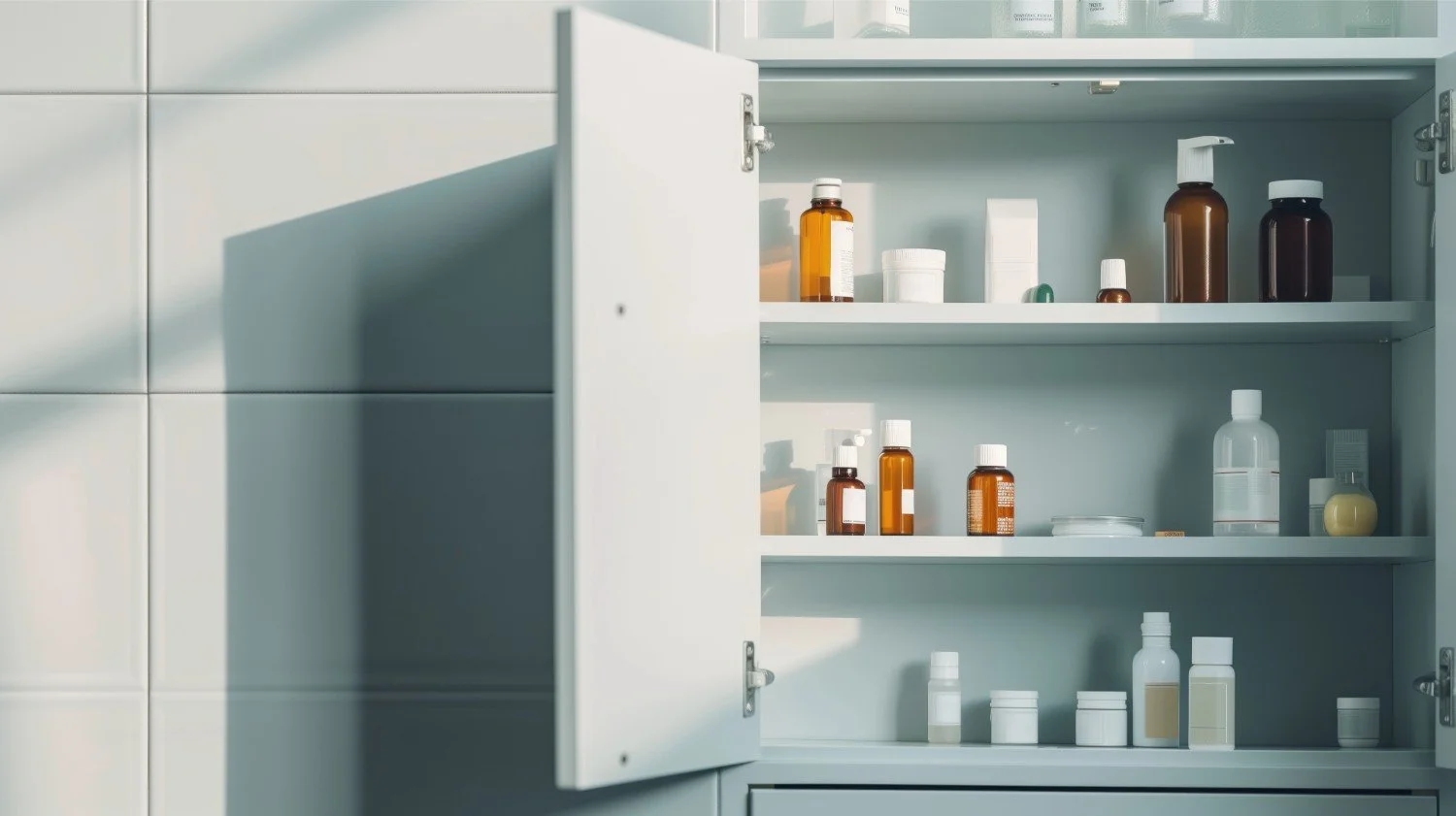
The Real Cost of Leaving Unused Medications in the Home
For years, we have measured the success of healthcare by how well we begin our treatments, and it is our belief that the next generation of healthcare providers will be measured by how well they help their patients complete them.
Modern healthcare has become extraordinarily sophisticated at the beginning of the prescription journey. We diagnose disease, develop remarkable therapies, select medications, dispense them with extraordinary precision, counsel patients about their use and increasingly monitor outcomes throughout treatment.
These accomplishments, resources and healthcare teams should be celebrated. Every prescription deserves a safe beginning and a safe ending. Yet while healthcare has become extraordinarily good at the beginning, there is a remarkably simple question we do not ask often enough: What happens when the medication is no longer needed?
A patient recovers from surgery. An acute condition resolves. A physician changes a prescription. A dose is adjusted. Medication is replaced by a newer therapy. A caregiver's loved one moves into another level of care. An antibiotic course ends. The medication is discontinued.
Treatment changes or ends, but too often, the medication remains, forgotten in a cabinet or saved for “future use.” When the therapeutic need ends but the medication stays behind, the prescription journey is incomplete and this is when a preventable Medication Safety risk remains in the home.
The Medicine Cabinet Crisis
Unused medication does not become harmless simply because the patient no longer needs it. In fact, the FDA says it quite plainly: keeping medicines after they are no longer needed creates an unnecessary health risk in the home.
The numbers help explain why. In 2020, there were an estimated 36,564 emergency-department visits among children age five and younger for unsupervised medication exposures. More than two-thirds involved children just one or two years old, and nearly 13% resulted in hospitalization. And these risks extend far beyond accidental exposure.
According to the 2024 National Survey on Drug Use and Health, among people age 12 or older who misused prescription pain relievers during the previous year, 42.3% obtained the pain reliever they last misused from a friend or relative in some way.
Those statistics are powerful. But opioids and accidental exposure are only part of a much larger Medication Safety conversation.
Prescriptions change every day. Dosages are increased or decreased. One therapy is replaced by another. Patients return home from hospitals with new medication instructions. Chronic conditions evolve. Acute conditions resolve. Yet the medicine cabinet does not necessarily change with them.
Research supported by the Agency for Healthcare Research and Quality helps illustrate the challenge. In one study examining medication safety as patients transitioned from hospital to home, 82% of patients visited at home had medication discrepancies, while 40% had experienced changes to their medications.
This is an important reminder that medications in our homes are not static. Our treatment plans change, our medications change, our diagnoses change, but the unused medication bottles already in our cabinets often remain and according to the CDC at a annual rate of an estimated 1.2 billion in the U.S. alone.
Antibiotics provide an especially important example. Many of us have probably looked at several leftover antibiotic tablets and thought, I may need those someday. But CDC specifically advises patients not to save antibiotics for later, warning that taking the wrong medicine for a future illness can delay the correct treatment and cause serious side effects.
That individual decision also connects itself to one of the world's great public-health challenges. The World Health Organization identifies misuse and overuse of antimicrobials as major drivers of antimicrobial resistance. Globally, bacterial antimicrobial resistance was associated with more than 4.7 million deaths in 2021.
The medicine cabinet in our home and global public health may seem worlds apart.
They aren't. Medication stewardship begins with understanding that every medication was prescribed for a patient, a condition, a dosage and a particular moment in that patient's care. When those circumstances change, our thinking about the medication should change with them.
The medicine cabinet is not simply a storage space. It is one of the last unaddressed frontiers of Medication Safety and home safety.
We Have Mastered the Beginning
Healthcare has invested extraordinary scientific, human and financial resources in getting the right medication into the hands of patients who need it.
Pharmaceutical innovation has transformed disease. Physicians have become increasingly precise in diagnosis and prescribing. Pharmacists, often our communities' most accessible connection to healthcare, help ensure medications are dispensed safely and patients understand their appropriate use. Technology increasingly supports adherence, clinical decision-making and patient engagement.
We have built an extraordinary healthcare system around starting and managing medication therapy. But when the dose changes, the prescription changes or treatment ends, responsibility too often shifts almost entirely to the patient. We have not built an equally consistent system for helping patients safely remove medication from the home when it is no longer needed.
That is where the prescription journey can break down—and where Medication Stewardship has an opportunity to complete it. Closing that gap can help providers, patients and families teach the next generation a healthier and safer way to manage the entire prescription journey.
The Real Cost of Doing Nothing
The cost of unused medication cannot simply be measured by the dollar value of pills left in a bottle. The greater cost is the unnecessary risk created when medication remains available after its therapeutic purpose has ended.
A medication prescribed appropriately for one patient can become accessible to a child, teenager, visitor or another family member. Multiple outdated prescriptions can create confusion for older adults and caregivers managing complex medication regimens. Changed dosages can leave multiple strengths of the same medication in the home. Discontinued therapies can be mistaken for current ones. Antibiotics saved for another illness can encourage inappropriate self-treatment. And controlled substances can create opportunities for diversion or misuse.
These are very different risks, but they share one thing: The medication no longer needs to be there.
Perhaps we therefore need to change the question. Instead of asking: What should people do with unused medication? We should be asking: Why are we allowing unnecessary medication risk to remain in the home in the first place?
Completing the Prescription Journey
Answering that question requires something larger than disposal alone. It requires Medication Stewardship and a shared understanding that responsibility for a medication does not end when it is prescribed, dispensed, purchased or even when the patient stops taking it.
A complete prescription journey connects prescribing, dispensing, patient education and medication management with the changes that naturally occur along the way, a new dosage, a different prescription, deprescribing or the end of treatment. And when a medication is no longer needed, that journey should include its safe removal from the home.
Medication Stewardship brings those individual moments together into one continuous commitment to Medication Safety, from a prescription's safe beginning to its safe ending.
If we can make that commitment part of how the next generation understands and manages medication, we have an opportunity to create safer homes, healthier families and stronger communities.
Pharmacy Can Help Lead the Next Chapter
Few institutions are better positioned to help close this gap than our community pharmacies. Pharmacists stand at one of healthcare's most important intersections: the place where the science of medicine becomes action inside the patient's home.
The opportunity becomes even clearer when we look at medication transitions. In the AHRQ-supported study referenced earlier, 88% of patients filled their discharge medications through community pharmacies. The researchers pointed to the significant and largely untapped role pharmacy can play in partnering with patients and family caregivers to support safe medication use.
Patients already turn to pharmacists with questions about interactions, side effects, adherence, dosage changes and medication management. Why shouldn't the safe completion of therapy become part of that same conversation?
Imagine a healthcare system in which every patient understands not only how to begin a medication safely, but how that medication should safely leave the home when treatment ends or changes.
That is not a departure from pharmacy's role, it is a natural extension of patient valued services that enable real world solutions to real world problems.
From a Disposal Event to an Everyday Behavior
Medication disposal has traditionally been treated largely as something patients must remember to do later: find a collection event, locate a kiosk, obtain a mail-back envelope or otherwise determine what to do after treatment has ended.
Each of these options can play an important role. But the larger opportunity is not simply creating more disposal options. It is changing behavior, understanding risk and making Medication Safety part of everyday life.
Safe completion should become a normal expectation of medication use, just as patients have learned to read labels, follow dosing instructions, store medications properly and consult their pharmacist when they have questions.
When a medication is no longer needed, safely removing it from the home should become as normal as filling the prescription was in the first place. It should become as instinctive as putting on a seatbelt or changing the batteries in our home's smoke detectors, small actions we take because we understand the risk they prevent.
A New Standard for Medication Safety
The next generation of Medication Safety can begin with a remarkably simple aspiration: The only medications in our homes should be those we or our families are actively using for legitimate acute or chronic healthcare needs.
Getting there will require more than any single product, company, profession or policy. It will require prescribers, pharmacists, manufacturers, health plans, caregivers, policymakers, public-health organizations and patients working toward a shared expectation. And it will require solutions that are practical, accessible, affordable and simple enough to become part of everyday behavior.
Because the best public-health solution is not merely one that works technically, it is one that people will actually use.
Every Prescription Deserves a Safe Journey and a Safe Ending
Healthcare has spent generations perfecting how treatment begins. Now we have an opportunity to complete the journey, reduce risks and support safer homes.
A prescription should not end with an unfinished bottle forgotten in a medicine cabinet. It should end when therapy has achieved its purpose, the patient understands what comes next and medication that is no longer needed has been safely removed from the home.
That is the promise of Medication Stewardship and it should become an underlying goal of Medication Safety throughout healthcare.
It is also the conversation we hope to advance through the Medication Stewardship Center: month by month, idea by idea, bringing together perspectives and resources that can help patients, caregivers, pharmacists, healthcare leaders and communities rethink the prescription journey from beginning to end. Because the future of Medication Safety isn't only about prescribing the right medication to the right patient at the right time. It is also about making sure every prescription has a safe journey and a safe ending.
So, as we begin this conversation, perhaps there is one question worth asking, one thought worth provoking, and one reason worth you getting involved: Have you ever asked yourself what happens to your medication when you no longer need it?
A NEW STANDARD FOR MEDICATION SAFETY
The only medications in our homes should be those we or our families are actively using for legitimate acute or chronic healthcare needs
Sources & Further Reading
DisposeRx — Medication Safety & In-Home Medication Disposal Resources — Research, education, public-policy perspectives, and resources exploring medication stewardship, safe in-home disposal, patient behavior, and the importance of safely completing the prescription journey.
FDA — Drug Disposal: Questions and Answers — especially valuable because FDA explicitly connects medicines no longer needed with unnecessary risk in the home and provides the pediatric exposure data.
SAMHSA — 2024 National Survey on Drug Use and Health — supports the 42.3% friend-or-relative source statistic for the most recently misused prescription pain reliever.
AHRQ — Patient-Centric Risk Model for Medication Safety During Care Transitions — supports the medication discrepancy, medication-change, and community-pharmacy points.
CDC — Antibiotic Do's and Don'ts — directly tells patients not to save antibiotics for later and explains why.
WHO — Antimicrobial Resistance — establishes misuse and overuse of antimicrobials as major drivers of AMR; WHO's current materials put the global scale at more than 4.7 million deaths associated with bacterial AMR in 2021.